Wednesday, September 21, 2016

Roadschooling, Two Months Later

Susanne is your driver for this post.

Sam began his fourth grade year seven weeks ago while we were parked in San Angelo, Texas. We were armed with several carefully-selected textbooks, a giant stack of notebook paper, and a perfectly-constructed scheduling grid that had our days laid out by the hours and minutes. Here's a flashback:


We followed the grid for maybe three days. It was a good approach in theory, but in practice, we needed a more fluid strategy. 

Almost two months later, we've adjusted. I'd say that we're close to center in the structured schooling-unschooling spectrum, and that's right where we need to be. Reading, writing, and mathematics are non-negotiable: we feel he needs a strong foundation in those skills and, based on his personality, benefits from a more structured approach in those areas. But he also needs freedom to explore what interests him, and that's where "unschooling" comes into the picture.

The more structured part of our homeschooling day takes place in the morning and includes the following:

1. Reading or writing (30+ minutes): I let Sam decide whether he'd prefer to start the day by reading or writing. He usually picks reading (I'm trying to figure out how to get him to write more without pressuring him so much that he despises the task). In the past few weeks, he's read the entire Diary of a Wimpy Kid series, a few Humphrey the Hamster books, and an I Survived novel. We're in the process of identifying another series that he'll truly enjoy. The Warriors by Erin Hunter is a strong contender.

2. Math (20-30 minutes): We're using Life of Fred for our math curriculum. Sam typically completes one chapter per day. The chapters are short, the writing is funny, and the problem sets are refreshingly brief. Each problem set comes with an answer key. It's up to him to check his answers when he's done. If he identifies any discrepancies, we discuss them and review that material. 

We reached a milestone yesterday when Sam wrapped up Life of Fred: Farming. Although closing the cover on a textbook is kind of an arbitrary way to measure progress, the fact that he completed it indicates to me that we're getting somewhere with homeschooling. We're moving forward.

3. Grammar (10-15 minutes, 3 times a week): To be honest, Sam detests grammar, but we're forging ahead anyway because I think establishing a strong foundation at this age is important. We're using using Scholastic's Success with Grammar for Grade 4. I figure that he can tolerate 10-15 minutes of verbs, nouns, subjects, predicates, adjectives, and prepositions a few times a week.

Then there's the less structured part of the day, which includes some of the following:

1. Field trips: Over the last few weeks, we've visited an aquarium, a bug exhibit and butterfly garden, several national monuments, a nature center, a natural history museum, a UFO museum (unsurprisingly, that was in Roswell, New Mexico), a cat cafe (yes, a cafe full of cats), a trampoline gym, and the plaza in Santa Fe. Of course, he also spent a week on an organic farm, and he often joins us when we run errands to the grocery store or Walmart. We use field trips in part for location-based learning and in part just to get out of the RV. 


As a kid, I remember going on field trips and having to fill in worksheets along the way. We don't do that. One, I'm too lazy to print out a bunch of papers and then cart them with us. Two, it's important for kids to immerse themselves in the experience and absorb whatever they can, from their own perspective. Some of their observations will have immediate relevance, whereas others will become more important later (perhaps much later). We view learning as a long-term endeavor that doesn't always require identifiable short-term outcomes. 

2. Video games: This makes us sound like slacker homeschool parents, but it's true. He plays video games, and often. Sam's current favorites are Minecraft and Kerbal Space Program. Minecraft encourages creativity and the development of spatial reasoning, whereas Kerbal Space Program - a rocket simulation game - integrates principles of astronomy, math, physics, and engineering. Both require problem solving skills, patience, and persistence. I was skeptical, but when your kid comes to the dinner table and starts talking about angles required to bring and keep a rocket in orbit around the moon, you start thinking that maybe video games aren't so bad after all.

3. Educational programming: Sam loves Cosmos, NOVA, and National Geographic. He's also a devotee of cooking shows (to the point where he took notes on Alton Brown's coffee recipe and can now produce the perfect morning brew). We let him watch as much as he wants; he polices his screen time pretty well.

4. Pursuit of big ideas: Like most kids, Sam is a creative thinker with big ideas. He wants to start a blog... create and sell art... own his own business... curate a coin collection... become a comic strip artist... write a series of children's books. We encourage him to explore these brainstorms because doing so requires him to think critically, problem solve, and apply his reading, writing, and math skills. Plus, we want him to know that he's capable of doing what he sets out to do. It's up to him to decide what he wants to do, how to do it, and what he needs. We're just here to help.


Everyone learns differently, so what works well for our family may not work as well for others. If you're a homeschooling/roadschooling parent, what approach works for you and your kids? What do your kids enjoy, and where do they struggle?

Friday, September 16, 2016

Our Experience with WWOOFing

A few months ago, while researching ways to save money on the road, we ran across a website for something called WWOOFing (WWOOF = World Wide Opportunities on Organic Farms). The basic idea is that you work on an organic farm for a pre-arranged length of time in exchange for food, accommodations, and a cool experience.

We're always looking for ways to reduce our heftier expenses, so I paid the $40 WWOOF USA membership fee and spent some time researching various WWOOFing options along our planned route through Texas, New Mexico, and Arizona. One small farm stood out to me: Sunflower River in south Albuquerque. Other WWOOFers had given it and its proprietors high praise.

Morning glory at Sunflower River
Our experience at Sunflower River

To learn more about Sunflower River, I contacted Kat Heatherington, one of the owners. She responded almost immediately, and through a long email exchange over several days, we worked out a plan: we would arrive in mid-August, stay at the farm for 3-4 weeks, and help with the harvest. They would provide a spot for us to park the RV, an electrical hookup, and full access to the community house on the property. Sam would be more than welcome on the farm; as part of his homeschool experience, he would have a chance to explore the gardens and learn about the chickens, turkeys, and peafowl. As a bonus, he and the little boy who live there could play together.

We arrived at the farm on August 19. Kat was waiting for us at the big gate leading into the property. Our first adventure was seeing whether the RV would actually fit through said gate (it's amazing how the size of our RV seems to change depending on the situation we are in... When in an RV park, it's dwarfed by the tall, shiny class A rigs, but in other instances - like this one - we feel like we're driving a tank). It did, and we pulled right into a flat, shaded spot next to Kat's cottage. We were able to plug into the 20 amp outlet on the side of the building and discovered that we miraculously had enough power for the A/C or the microwave, though not at the same time.


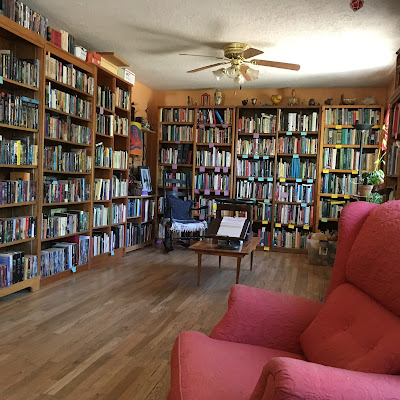
Once we were settled, Kat gave all of us a comprehensive tour of the property, which consists of vegetable gardens, a cottage (it houses an impressive library of books that interns are encouraged to peruse and borrow), bird pens, a barn, a community house, or mahazda (which the Sunflower River stewards renovated entirely on their own), a sand pile and playground structure, a ritual ground (for ceremonies, I think, though we were not present for any), a festival area, and fields that seemed to stretch for acres. The farm is large, but deceptively so: it's narrow and gives the impression of being rather small at the front, but it extends back and back and back, all the way to an acequia (irrigation ditch) and, beyond that, the Rio Grande River.

The turkeys, which the farm raises and then sells at Thanksgiving
The garden was bursting with tomatoes
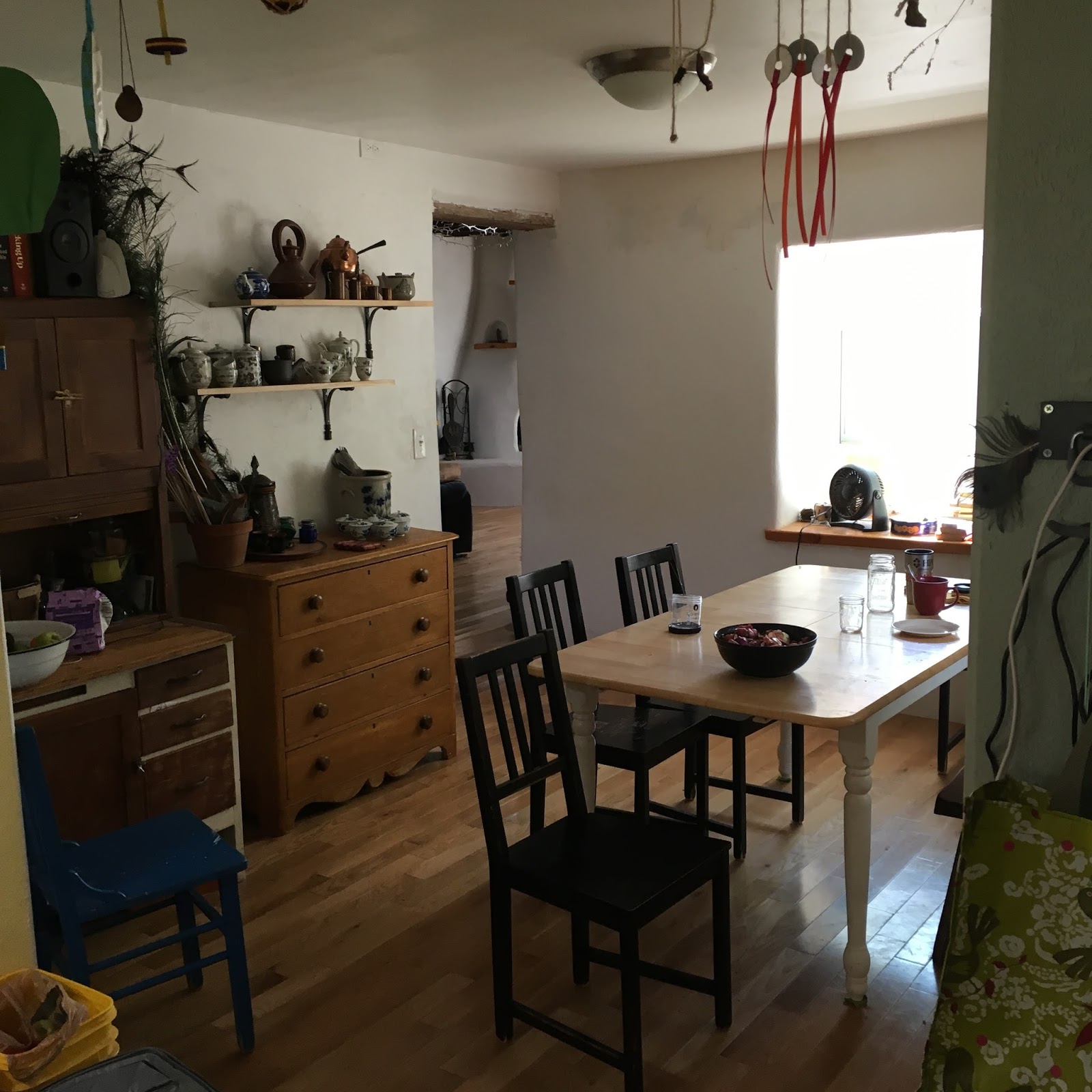
Dining area in the mahazda
Kitchen in the mahazda
Library in the cottage
Kat explained that interns are expected to work at least 20 hours a week, but how we managed our time was totally up to us. Nobody was going to be banging on our RV door at 7 AM, telling us to get started. We could work at our convenience, particularly during the week when most of the farm stewards (as the primary residents call themselves) were at their regular day jobs. 

After we settled in, we wandered over to the community house to decide what our first farm tasks would be. Sunflower River has an extremely organized method of task distribution. On the wall in the kitchen hang several whiteboards covered in Post-It notes. Some Post-Its list tasks just for the stewards, while others list chores that interns (working visitors) can take. Every week, the stewards hold a meeting to decide which tasks are most crucial, and they make those available to interns. Each intern is expected to select 2-3 of those tasks and complete them before selecting new ones. If questions arise, another whiteboard lists the steward-on-call for the day as well as their phone number.


In other words, we were impressed by the efficiency.

We selected a couple of smaller chores, such as weeding and plucking grapes from the vines around the ritual grounds, but the task that required most of our working time while at Sunflower River was clearing one of the large back fields. Dense thickets of sunflowers had completely taken over to the point where walking from one side of the field to the other practically required a machete. Moreover, this sunflower forest had become a haven for thousands of grasshoppers that had invaded the property in the spring. Because Trent and I both enjoy repetitive manual labor (who knew? but apparently we do), we gathered gloves, wheelbarrows, and shovels and dove in. Over the course of a week, we cleared approximately 3/4 of the field and displaced many grasshopper families ("Do you realize what you're doing to them?!?" Sam would exclaim from the sidelines as we worked. I actually started to feel a little guilty.)

Trent working the wheelbarrow
Sam helping out in the sunflower field
Sweaty but enjoyable work
One of the eight bajillion grasshoppers hanging out in the sunflower field
On one of the last days we were there, we helped clean out the turkey, chicken, and peafowl pens. Of all the jobs we completed, that was the most physically demanding. The turkey run had flooded thanks to a combination of monsoon rains and a faulty watering system, turning the bird poop, straw, and soil first into a dense sludge and then, once it finally dried, something resembling toxic-smelling concrete. It took five of us armed with spades, shovels, and wheelbarrows to remove the heavy layer of fly-infested grime and replace it with fresh straw. The chicken and peafowl pens were a breeze in comparison.

We also had the opportunity to do some work at another local farm a few miles north of Sunflower River. There, the owner needed to clear out his garage so that he could create a space for a permaculture workshop. We spent an afternoon organizing the usual items one finds in a garage storage space, carting them across the property to the barn and workshop, eating some delicious homemade vegan food, and getting to know some of the other farmers in the Albuquerque area.

Taking a break after work at the north Albuquerque farm
At Sunflower River, Sam was particularly interested in harvesting the grapes and chatting with the chickens, but a few days in, it was clear that his favorite activity was playing in the sand pile with Gawain, a chatty, kind, and clever little person whom Sam took to immediately. The two of them would design and build cities of pyramids, then destroy them with landslides. It amused them for hours. Jenny, one of the stewards and Gawain's mom, seemed to share our if-they're-happy-let-them-play parenting style, and so sometimes the two of them would be out there well past dark.

Harvesting grapes
Trent attended one of the weekly Sunflower River community meetings. At the meetings, the property owners/stewards share a meal, talk about what was accomplished the previous week and what the work priorities are for the upcoming week, and hash out any issues or conflicts. After the meeting, Trent commented that the stewards have an impressive diversity of experience, education, expertise, and interests to bring to the farm and the community.

Why we left early

I have a terrible habit of taking on too many things at once. I don't mean to, and yet I do it repeatedly. There's a disconnect between what I think I *should* be able to take on and what I can actually do, and ultimately it was this disparity that prompted us to leave Sunflower River well before the month was up.

In addition to our farm work, we had an armful of other obligations to meet. I was homeschooling Sam and facilitating an online class. Trent was working his 35-hours-a-week publishing job. Both Trent and I were trying to keep up with the blog and our social media accounts. I was training for my upcoming marathon. Plus, I wanted to explore Albuquerque with Sam. Then there were the other everyday chores: laundry, tidying the RV, preparing meals. And, as someone pointed out to me, we're still adjusting to this whole living-and-traveling-in-an-RV situation. That takes energy, too.

It was just too much. Maybe it wouldn't be overwhelming for everyone, but it was for us, and so we decided to leave. Kat and the other stewards were very gracious and understanding, which was a total relief as I was worried that our departure would offend them and/or upset their plans. 

They took it in stride, maybe in part because they're just that zen (they certainly seemed to be), or maybe because they have years of experience in working with interns. Plus, the way they structure their task system is such that farm operations are somewhat buffered by unexpected events.

Would we recommend WWOOFing to other RVers?

Absolutely! It's a great way to connect with a local community, make new friends, learn about organic farming, and save some money. And anyone can do it. You're 19 years old and need a change of pace? Try WWOOFing. You're 85 and need a change of pace? Try WWOOFing.

That said, make sure you know what you are getting into. That's our first piece of advice: whether it's via phone or email, make sure you and the owner of the farm are on the same page. Ask questions. Ask a lot of questions, and do not hold back. Be clear about what your needs are in terms of accommodations, facilities, RV hookups, etc. If you have children, make sure they will truly be welcome, as Sam was at Sunflower River. You don't want to wait until you get there to have these conversations. If the owner balks during these preliminary discussions, well, that's some valuable information you can use to help you decide whether WWOOFing is right for you.

In fact, one of the best things about our experience was how communicative Kat and the other stewards were about their needs and expectations. From her very first emails, Kat let us know what they most needed from us, and we appreciated that. 

Second, read the reviews from other WWOOFers. Once you're a member of WWOOF USA, you can see what other WWOOFers have to say about a particular farm. Trust me, not all farms get stellar reviews! The comments for Sunflower River were excellent and helped us make an informed decision.

Third, evaluate your schedule as honestly and critically as possible to see whether WWOOFing really fits in. If you're working from the road and homeschooling your kids, do you have the time, energy, and patience to put in the hours on a farm? Sure, maybe you'll save some money, but will it be worth the stress?

Fourth, be aware that WWOOFing may come with some inconveniences. For instance, because we were hooked up to a regular 20 amp electrical outlet, our electricity repeatedly shut off (not much of a problem given that temperatures were cool and we had access to the community house). We didn't have water or sewer hookups, so whenever we wanted to cook, wash dishes, shower, or use the bathroom, we had to trundle over to one of the buildings to use their facilities (again, generally fine, though kind of a pain when you have to pee at 3 AM). In other words, expect to exercise flexibility and a roll-with-it attitude.

Finally, expect to learn something about yourself: 
  • I learned that extensive contact with sunflower stems and certain weeds makes me break out in hives, seeing chickens and turkeys cooped up in pens really bothers me (darned vegan that I am), grasshoppers are kind of cute even when they're accompanied by thousands of their friends, and I have a chronic tendency to overestimate my bandwidth. 
  • Trent learned that the Progressive Industries EMS-PT30C Portable EMS RV Surge Protector was a great investment. It protected us when the voltage dropped on our weak 20 amp hookup, and it prevented a high amp draw which could have damaged our electrical gear. He also learned that, although partial hookups are fine in theory, realistically, he'd prefer to have full hookups. I have to agree. Maybe that makes us RV wimps, but that's where we're at right now.
  • Sam learned that he really loves harvesting grapes. (I'm hoping he'll want to own a vineyard one day. That would be rather convenient.)

Will we WWOOF again?

Maybe at some point, but for now, probably not. We're still trying to get our bearings with the RV lifestyle. We're going to focus on establishing consistent paid work, homeschooling, writing, and finding reasonably-priced accommodations as a way of conserving money. That said, when we see opportunities to volunteer in or otherwise get involved with the local community, we will do that.

If you have questions about WWOOFing, or if you have your own WWOOFing experiences to share, please post them!

Wednesday, September 14, 2016

Campground Expenses, August 2016

Susanne is your driver for this post.

For the bulk of August, we stayed at two sites: San Angelo State Park in San Angelo, TX and Red Barn RV Park in Roswell, NM. Here's a breakdown of our August campground expenses:

August 1-14: San Angelo State Park. During the hot, steamy days of early August, the park was practically empty. We landed one of our best campsites so far: flat pad, covered picnic area, gorgeous view of the lake, huge shade tree, and electrical and water hookups. The dump station was located less than a mile from our site - not much of an inconvenience. If I recall correctly, we earned one free night because we'd purchased a Texas state parks pass the month before ($70), and the officer at the ranger station gave us an additional, unofficial discount related to our length of stay.


Total cost: $200

August 14-26: Red Barn RV Park. As Trent described in a previous post, this diminutive campground, tucked between a busy road and an alfalfa field, is a gem. It offers a flat pad, full hookups, access to coin laundry, and an exceptional staff. We'd originally planned on staying less than a week but extended our stay once we realized how outstanding the amenities were. The proprietor offered us a 10% Good Sam discount on the second half of our stay.


Total cost: $302.61

August 26-30: WWOOFing at an Albuquerque farm. In an effort to immerse ourselves in the local community and save some money, we tried our hand at WWOOFing (WWOOF = World Wide Opportunities on Organic Farms) when we arrived in Albuquerque. In exchange for manual labor on the farm, we received free electrical hookups, access to a community house with full facilities, education regarding organic farming, and some good company. We cut our stay short, but it still helped us conserve some of our cash in the last days of the month.


Total cost: $0

Campground totals for August: $502.61

What we learned in August about saving money on campground expenses:

(1) Generally speaking, the less you move around, the less you'll spend. We found places that had decent rates and amenities, and then we hunkered down. By not moving, we saved on gas for both the RV and the car (or as RVers call their cars, "toads").

(2) The advertised price isn't always set in stone. Our experience at San Angelo State Park was a good example of this: we received an additional, unadvertised discount once we arrived and connected with the park staff. Perhaps part of this had to do with the scarcity of campers at the campground; maybe they wanted to encourage us to stick around. Or maybe the ranger just wanted to give us a bit of a break.

(3) You can save money by not following the crowd. Texas sizzles in the summertime, and we can see why RVers prefer to reserve their visits to the Lone Star State for the winter months. We're shocked that our air conditioner handled the high temperatures with such aplomb. On the other hand, we were able find campsites that were extremely inexpensive, and that made it worthwhile.

We'll post our September breakdown in a few weeks. We're moving around more this month, and as you'll see, our camping expenses will be higher as a result.

Friday, September 9, 2016

How long do we stay in one spot?

Susanne is your driver for this post!

Another question people frequently ask us: How long do we stay in one spot before moving on?

Generally, we try to move no more often than every two or three weeks. The reasons for this are multifold:

  • We don't want to burn out. Moving from one site to another - even if it's just an hour or two away or simply across town - is exhausting. It means cleaning out the tanks, unhooking all of the hoses and pipes, straightening up the interior and securing any breakables, pulling in the slideout, getting the cat situated, sometimes backing out of tricky parking spots, and planning our route. That might not sound like that much... and it isn't, if we don't do it too often. But if we were to do all that every few days, we'd be totally exhausted. It might be a good way to vacation for a couple of weeks, but it's not a good way to live over the long haul.
Clark the Freelander, just relaxing in camp
  • Gas is expensive. Our Coachmen Freelander has a fuel efficiency of about 9 miles per gallon and a total fuel capacity of 57 gallons. Let's say gas costs $2.80 a gallon. If we were to fill the entire tank (which, granted, we never do), that's almost $160. Thus, driving long distances on a regular basis just isn't practical for us.
  • We need time to work as well as play. We certainly go out and see the sights, but we're a working class family with a kid in grade school. That means that more often than not, we spend our days working and homeschooling. Much of our week is dedicated to these tasks, and we couldn't do them properly if we were constantly on the move. For us, it would be too overwhelming.
Office space
  • At the same time, we strive to immerse ourselves in the local community. By staying several weeks in one spot, we give ourselves a chance to see the sights, eat local specialties, find good running and hiking trails, and tailor our homeschooling activities to what's available in the area. We've been in Albuquerque since the end of August, and we've become quite familiar with the layout of the city (always a comforting feeling) and the location of area parks and recreation opportunities. Sam and I have made field trips to the local aquarium, the BUGarium, a trampoline gym, a cat cafe (yup, you read that right!), Petroglyph National Monument, and some area volcanoes. We've even identified a favorite Thai place.
Working
Aquarium
Petroglyph National Monument
Volcano hike

Cat cafe! Such a happy place.
What about you? How often do you and your team move from place to place? What's your idea of an ideal amount of time to stay in one spot?

Sunday, September 4, 2016

How we decide where to stay

Susanne is your driver for this post.

A few nights ago, we stayed up late planning our route for the next couple of months and posted some of our ideas on Facebook. One of our friends messaged us to ask how we go about selecting our destinations and campsites, so I thought I'd share our route-planning and campsite-picking process.


1. We have a long-term route in mind. Our overall plan is to mosey through New Mexico and Arizona into southern California before moving northward through NorCal, Oregon, and Washington. Everything is dictated by this long-term route, though we have no idea how long it'll take to implement said plan.

2. We think about people or places we want to see. For instance, a couple of months back, we traveled through Austin, TX because we wanted to visit our friends and housesit for them. At the end of September, we're going to Santa Fe: I hear it's just too good to pass up. After that, we'll be heading to the Grand Canyon because we want to give Sam the opportunity to see this amazing national park. Thus, specific attractions play a significant role in influencing where we go.


3. Climate. Although we made the crazy decision to spend most of our summer in Texas - mainly to establish residency there - we want to make a habit of following the weather to avoid extreme temperatures. That way, we won't have to overtax our (currently exhausted) air conditioner or rely too much on the heating system. 

4. Cost. Three months in, we're realizing that we feel most comfortable (and efficient, in a work sense) when we stay at campgrounds with full hook-ups, level spots, and good light. At the same time, we can't afford to pay an arm and a leg, and that's challenging. For example, KOAs offer loads of amenities, but many of them cost $40 or even $50 a night. That's way too expensive for us. We actively seek out RV parks and campgrounds that are more economical.

As part of our cost considerations, we look for Thousand Trails parks close to our desired destination. Because we're Thousand Trails members, we can stay in a Thousand Trails park for up to two weeks, with full hookups, on relatively level ground, at no charge (the only caveat is that we have to be "out of the system" for a week before returning to another TT park). If there's a TT in the general area, that's where we go.


5. Reviews from other RVers. If a campsite is in a good location and offers a reasonable price, our next step is to check online reviews to see what other people have to say about it. To research campgrounds, we check Campendium, RV Park Reviews, and Google reviews. Sometimes we also check with our full-time RVer forum on Facebook. These reviews are crucial: a park can be well located and look pretty in pictures, but if customer service is bad or if the utilities aren't working properly, we don't want to stay there.

6. Quality of Verizon coverage. Trent's work takes place entirely online, so he requires a strong, reliable Internet connection. We obtain our connection through our Verizon unlimited plan, so Verizon coverage is a major priority. Once we've found an affordable campsite, we research the quality of the cellular signal there first by checking the Verizon Coverage Map and then by scoping out reviews on Campendium. The Verizon Coverage Map is fairly accurate, but if a campground is "on the edge" in terms of signal quality, we can't always tell. That's when the Campendium reviews, which include very specific information and ratings of cellular coverage, are vital.


So that's how we do it! Sometimes it feels lot like putting together a complicated jigsaw puzzle or solving a Rubik's cube, but so far the effort has been worth it. We've generally enjoyed every place we've stayed. 

For other RVers: What's your typical process for deciding where you're going next and where to stay?

Tuesday, August 30, 2016

Red Barn RV Park in Roswell, New Mexico

Trent is your driver for this post.

We stayed at the Red Barn RV Park in Roswell, New Mexico in August, 2016 for just under two weeks. Our original travel plans had us here for a week but after a few days we realized we loved the park and wanted more time to explore Roswell.

Red Barn RV Park HQ


Back entrance to the Red Barn

The Verizon coverage (15-21 Mbps) here is great without an antenna or booster and the park, as advertised, really does have fast Wifi (~20-50 Mbps). If you work online using Verizon this is a great park because you will have two great ways to get online. It's always nice knowing you have a backup in case your primary system has problems.

The Red Park RV park is small. There are just 14 rv spots and a place for one or two tents. Lee, the women who runs the show here, is super friendly and the small size of the park means she stays on top of everything (in a good way) and keeps it looking great.
RV park in distance from dirt road on farm behind the park.
Our spot for the first week

The sewer, water, and electrical hook ups were all in good condition and worked as expected. The sites were all flat as far as we could tell. We used two spots and were level right off the bat on both. There is one coin-operated front loading washer and dryer that worked great.


There is a nice lounge/working area in the "Barn" with a TV, books, and a few games. There are also some snacks and drinks you can buy at any time using the honor system where you just drop money in a lock box. I worked in this area almost every day. The internet was stable, fast, and free with the stay. The park does offer free cable with a deposit on the required cable box; we didn't get the cable since we were able to pick up Olympic coverage with our antenna and that's about the only thing we watch on broadcast TV.


The owners of the park are friends with the farmers that own the fields around the park. This allows guesting staying at the park to walk on the dirt roads in the fields behind the park. It was nice to have a good place to walk and look for aliens at night.


The bottom line for this park is we would go out of our way to stay here again.

Wednesday, August 24, 2016

Nomadic McDowells: A (Current) Day in the Life

Susanne is your driver for this post.

People often ask us what it's like to RV full time. Many seem to think that we explore national parks by day and roast s'mores over the campfire by night. That rosy image reflects our reality about 0.01% of the time.

In truth, living in an RV is a lot like living in a house, except that the RV moves and we have to go to a Laundromat if we want clean clothes.


To clarify what the RV lifestyle is like for us at this particular time, I thought I'd provide you with a day in the life glimpse of our lives on a regular weekday. It varies, of course. Sometimes we do take the entire day to see a national park. But more often than not, this is what it looks like:

6:30 AM: Nobody is up... except our feisty orange feline. Biscuit has arisen, and she's raring to go. Biscuit greets every new day with the frantic conviction that her humans will never wake up; her gut reaction is to meow and attack our feet until someone responds. Trent usually gets up first, soothes the cat, freshens up her food, eats breakfast, cracks open his laptop, and gets some work done while Sam and I are still asleep.


7:30 AM: If it's a running day for me, I go out for a run somewhere close to the RV. 

9 AM: Sam is usually up by now and watches some TV to help him ease into his day (current favorite shows: Cosmos, Fixer Upper, and Good Eats). I take a shower (hot, if we've remembered to turn on the hot water heater), make coffee (one of my favorite daily rituals), and prepare breakfast for myself and Sam.


10 AM: Trent "goes to work" - that is, he leaves the RV to find a quiet spot in the campground rec center or office. If we're at a site with full hookups, he'll check the tank levels and empty the gray and black tanks on his way out.

Sam and I get started with homeschooling. His daily tasks always include reading, writing, grammar, and math, though we don't spend much time on any one thing. That's the benefit of homeschooling: he can work on each task at his own pace, and if/when he gets tired, we move on.


While Sam tackles schoolwork, I blog (either for Nomadic McDowells or my running blog), update our social media accounts, communicate with my Beachbody clients, and facilitate my online geology class. 

Noonish: Sam wraps up his work. I make lunch for both of us. Nothing fancy. Sam's into smorgasbords these days, so he likes some combination of fruit, yogurt, crackers, and cheese. I typically have a salad or heat up leftovers from the night before. Trent usually comes back to the RV to make one of his special wraps: flour tortilla, peanut butter, and spinach. Mmmmm.

1 PM: On about half the days, Sam and I (and Trent, if he's not too swamped with work) go on a field trip to a park, the local library, or an area attraction (for instance, we went to the Bitter Lake National Wildlife Refuge and the UFO Museum while here in Roswell, NM).


On other days, Sam comes up with a project and works on that while I get my own work done. His projects are almost always self-directed. So far he's set up a website, developed his own art business, read history books, painted, and started a coin collection.


Afternoons can get tricky because Trent and I always have work to do, whether that's for the companies we freelance for or blogging/social media. On one hand, we don't want to spend our entire nomadic existence on our computers, but the fact of the matter is that we aren't independently wealthy. The bills have to get paid.

4 PM: I start eyeing the beer in the fridge. Sam reads or plays a video game. Biscuit naps in preparation for another night of terrorizing her humans.

5 PM: We make dinner. We have a toaster oven and an InstantPot, and for the most part, these two appliances allow us to make anything we want. The InstantPot is nice because a) it's fast and b) we can program it and walk away.


6 PM: Dinner! We squeeze around our little RV table. It can get tight, especially if we've let clutter accumulate. We do eat outside sometimes, but between the heat and the bugs this summer, that hasn't been as appealing as it sounds. We anticipate dining in the great outdoors more as we get into fall.


7 PM to bedtime: If we're at a regular old, nothing-special-here site, we do what many other people do in the evenings: clean up, play with the cat, take walks, watch Netflix, text with friends, read, veg out. At our current location, we're basically situated in a large (but nicely maintained and landscaped) parking lot next to a busy road, so there's no huge incentive to commune with nature. If we're at a national park or some other particularly beautiful place, we'll spend more time outside.


So that's about it! Does anything surprise you? Anything you're still wondering about? For our fellow travelers/nomads, how does this compare to your daily schedule?